















Sculptra vs Dermal Fillers: What's the Difference?
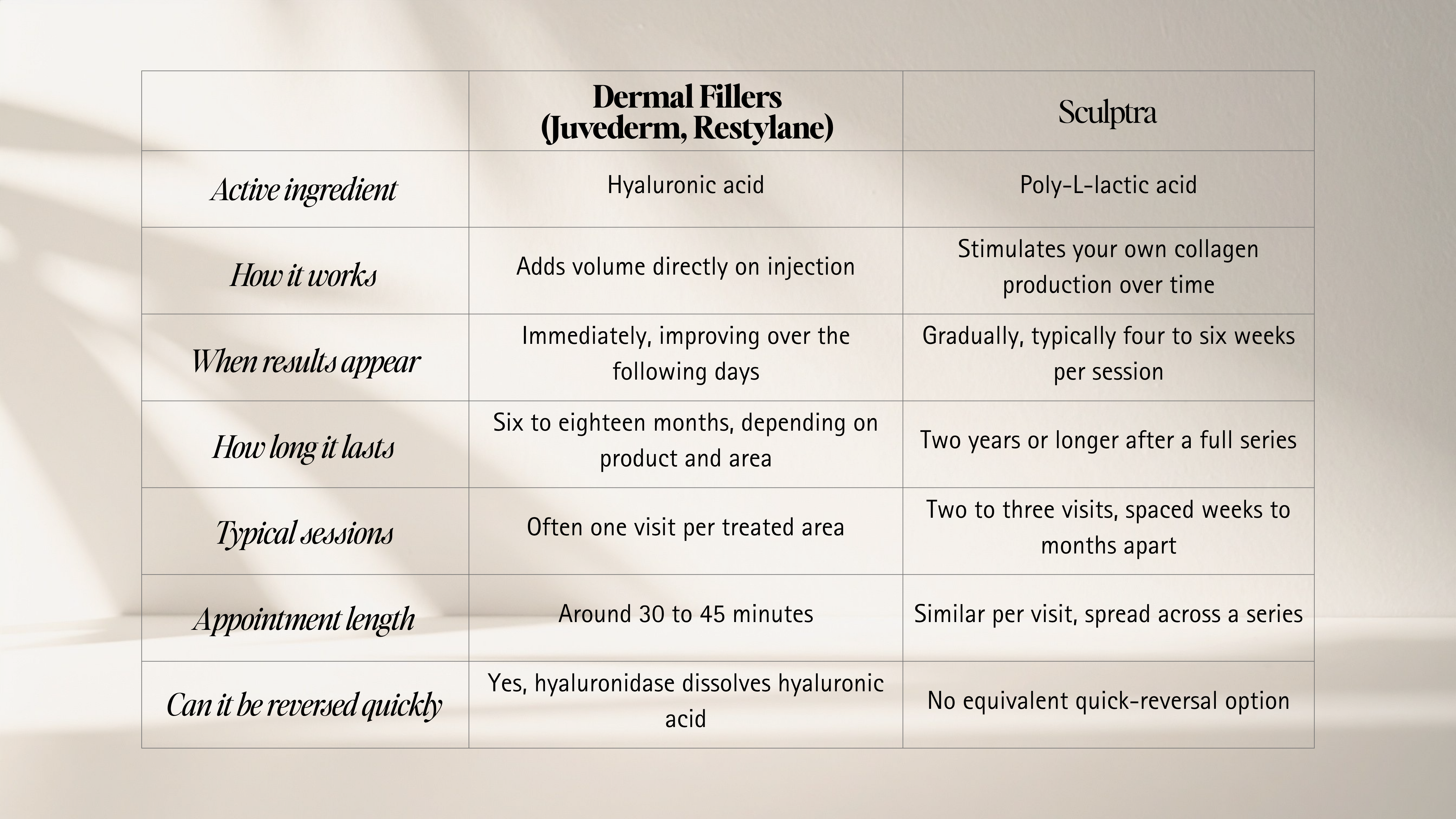
Timing, mostly. That's the real difference between Sculptra and a dermal filler, more than which one is "better." Fillers like Juvederm and Restylane use hyaluronic acid, and it adds volume the second it's injected, typically holding for six to eighteen months. Sculptra takes the long way around: poly-L-lactic acid gets your own body to build new collagen over months, and once a full series is done, that can hold for two years or more. What Sculptra actually is and how it works covers that mechanism in full if you haven't read it yet, how long Sculptra results last goes deeper on the longevity side, and Be Beautiful's dermal filler page has the details on the HA side of things.
Table of Contents
Why Sculptra Takes Longer, on Purpose
Longevity Isn't the Whole Story
A Realistic Way This Plays Out
The Comparison at a Glance
Why Fillers Feel Instant
Hyaluronic acid fillers work by physically taking up space under your skin. Inject Juvederm into a hollow cheek and the volume's there before you're even out of the chair. Be Beautiful's own filler page notes results show up immediately and keep refining over the next few days as any initial swelling goes down.
They're built for one specific line, fold, or hollow, the kind of thing you want handled before an event next month. Durability's the tradeoff. Hyaluronic acid is a substance sitting in your tissue, and your body wears it down gradually, so most areas need a touch-up somewhere between six and eighteen months out.
Why Sculptra Takes Longer, on Purpose
Poly-L-lactic acid isn't playing the same game as hyaluronic acid at all. Per Cleveland Clinic, it triggers your own cells to start producing new collagen right at the injection site, and that takes weeks to show up for a simple reason: collagen production takes weeks, period. A peer-reviewed study on PLLA published in Cosmetics, funded by Sculptra's manufacturer Galderma (which matters when you look at the specific percentages), found dermal and adipose layer thickness up roughly 26 to 27 percent nine months post-treatment, with collagen still forming for eight to twenty-four months after injection.
You'll look about the same walking out as you did walking in, and that's the plan working exactly as intended. Providers train to under-treat at each session on purpose, since the real result depends on your own tissue catching up gradually over the following months. A single syringe was never going to get that done in one visit.
Longevity Isn't the Whole Story
On paper, Sculptra wins the "which one lasts longer" argument outright. But durability cuts both ways once you actually compare the two. A filler you're unhappy with can usually be adjusted or dissolved with hyaluronidase in a couple of weeks. Sculptra doesn't have that option: hyaluronidase only breaks down hyaluronic acid, so it does nothing to the poly-L-lactic acid Sculptra is made from. Once it's in, there's no adjusting it for those two-plus years, which is exactly why the consultation and the provider's technique matter more upfront than they do with a filler.
Can You Combine Them?
Plenty of Be Beautiful clients use both, aimed at different areas of the same face. Some also add Morpheus8 to the plan, since surface tightening and volume rebuilding are solving two different problems at once. A typical combination looks like Sculptra handling the broader volume loss across the cheeks or temples over a series of visits. A smaller amount of filler handles something specific on top of that, like lip shape or a single deep fold, usually in one sitting. You're not locked into just one option.
Timing them together takes some planning. Because Sculptra results build in slowly, a provider mapping out a combination plan usually spaces things out so a filler doesn't mask the exact area where they're tracking how well the collagen response is coming along. It's mainly a scheduling detail to raise directly with your provider if you're considering both.
A Realistic Way This Plays Out
Picture two people in the same consultation room, same day, totally different problems. One's got a single deep fold along the side of her nose that's bothered her for years, and she wants it visibly softer before a family event in three weeks. The other's noticed his whole midface looking flatter than it used to. Nothing specific, no single line he can point to, just an overall loss of fullness that crept up over several years.
She's a strong filler candidate. Hyaluronic acid handles that one fold directly, the change shows immediately, and there's a reversal option if it's not quite right. His situation is the one Sculptra was actually built for: no single line to fill, just broader volume loss spread across an area, exactly the kind of structural rebuilding a collagen stimulator handles better than a filler ever could. A filler would need placing in several spots, topped up repeatedly, just to chase the effect a Sculptra series builds on its own.
Two different problems, two different answers. A real consultation's job is figuring out which question you're actually asking before any product gets picked.
A Few Terms Worth Knowing
Hyaluronic acid is the naturally occurring substance in your skin that holds water and volume, and it's the base ingredient in fillers like Juvederm and Restylane. Sculptra is built on a different compound: poly-L-lactic acid, synthetic and biodegradable, which stimulates your own collagen production at the injection site. Then there's hyaluronidase, the enzyme providers use to dissolve hyaluronic acid fillers when needed; since it only targets hyaluronic acid, it does nothing to Sculptra.
Which One Actually Fits You
A specific area you want addressed before a wedding six weeks out points toward a filler, since the timeline doesn't leave room for a gradual buildup. A broader, slower loss of fullness that's been building for years points the other way, toward Sculptra's gradual approach and longer-lasting results, especially for someone who'd rather come in a few times over a year than maintain touch-ups every six months indefinitely.
Most people land somewhere in between those two examples, and a provider looking at your actual face, not a hypothetical, is what actually settles it.
Frequently Asked Questions
Is Sculptra better than dermal fillers?
Depends what you're solving for. Fillers work faster and you can reverse them with hyaluronidase if you change your mind. Sculptra takes longer to show up but tends to stick around a lot longer once it does.
Can I get Sculptra and dermal fillers at the same time?
Plenty of people do, usually Sculptra for the broader volume loss and a filler for something more specific or time-sensitive. Your provider sequences it so one doesn't undercut the other.
Which one hurts more?
About the same. Both include lidocaine in the product itself, and topical numbing's available either way if you want extra.
If I don't like my Sculptra results, can it be reversed?
No, not the way a filler can. Hyaluronidase only breaks down hyaluronic acid, so it does nothing to Sculptra. Pick your provider carefully going in, since there's no quick undo button waiting on the other side.
Why would I choose Sculptra if it takes longer to work?
Because of what happens after. Sculptra can hold for two years or more, versus six to eighteen months for most hyaluronic acid fillers, so you're back in the chair less often over time.
There's no outright winner in the Sculptra vs dermal fillers debate, and anyone who tells you otherwise is selling something. What actually matters is what you're trying to fix and how soon you need to see it, and our providers can help you work that out at a consultation, not from a blog post.
This article is for general education and isn't a substitute for personalized medical advice. Talk with a Be Beautiful provider about your skin and health history before starting any treatment.