





PDGF vs PRP: What's the Difference?
Source, mostly. PRP comes from your own blood, spun down in a centrifuge to concentrate whatever growth factors happen to be circulating that day. Ariessence Pure PDGF+ skips your blood entirely. It's a single growth factor, PDGF-BB, manufactured to a fixed standard and delivered the same way every time. What Ariessence Pure PDGF+ actually is covers that product on its own, how PDGF repairs and renews skin goes deeper on the biology behind both treatments, and Be Beautiful's PRP Facial page has the details on the blood-based side of this comparison.
Table of Contents
The Comparison at a Glance
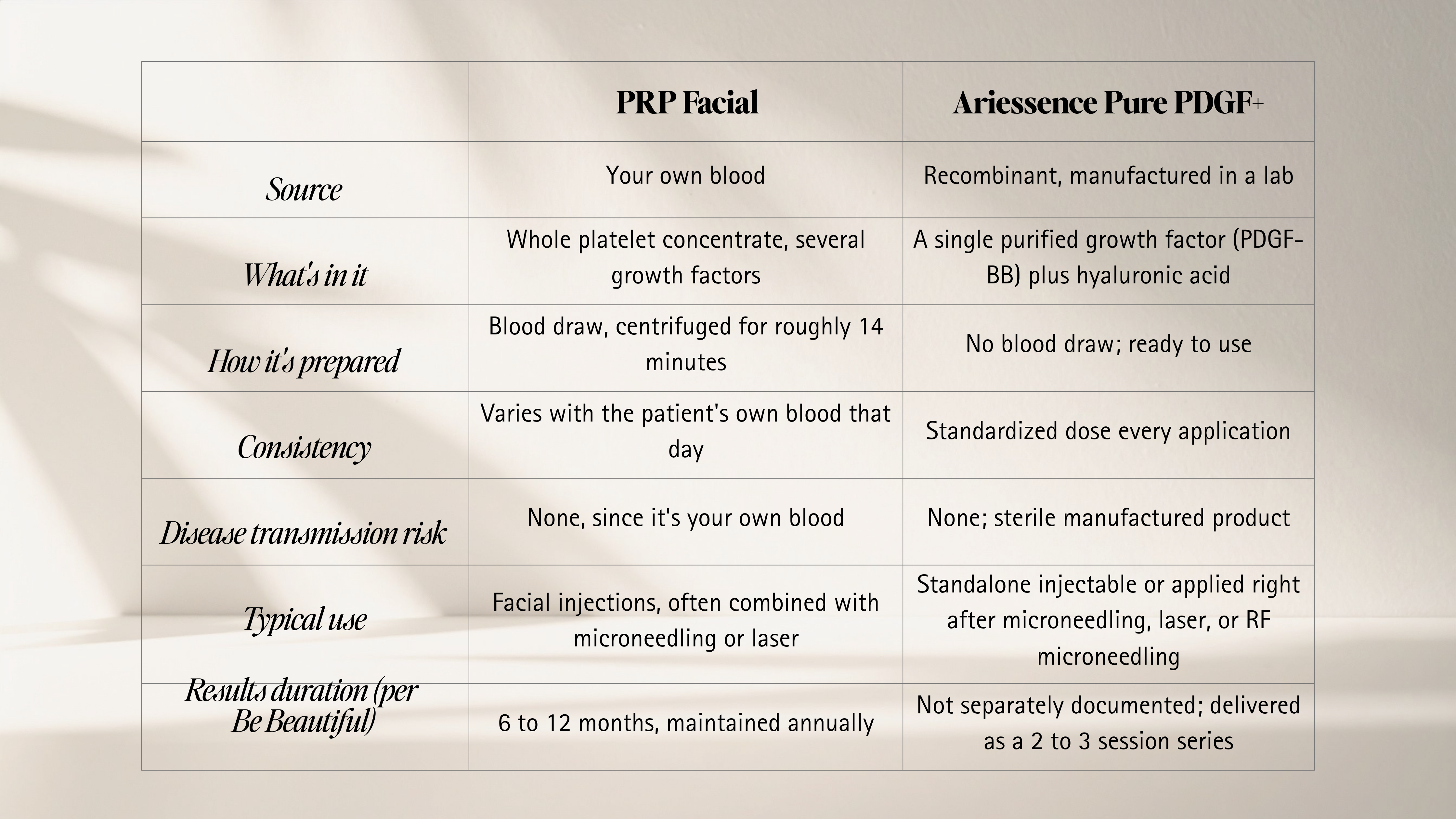
Everything below just unpacks why that table looks the way it does, starting with what each one is actually made of.
What PRP Actually Is
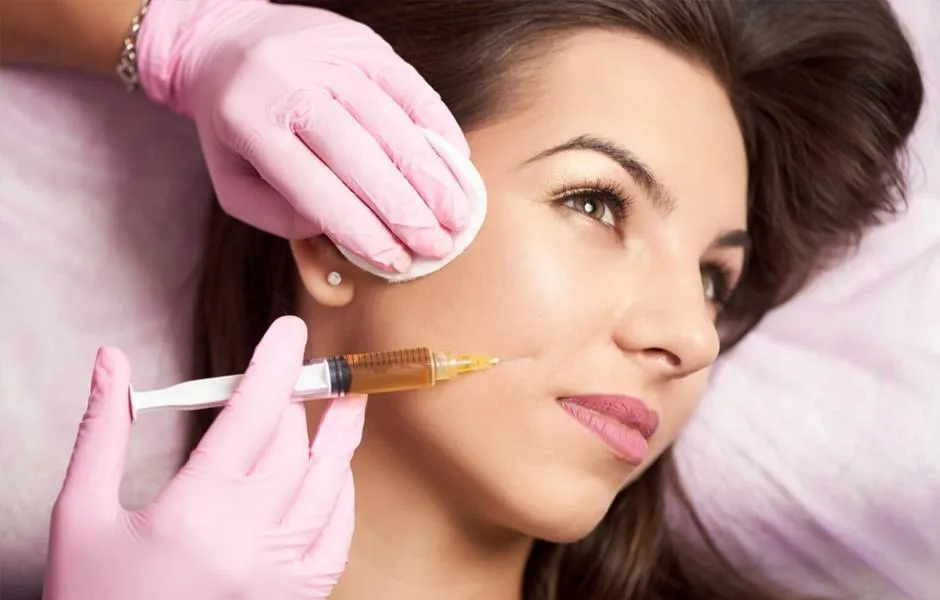
PRP stands for platelet-rich plasma, and Be Beautiful's process is exactly what it sounds like: draw blood, spin it in a centrifuge for about 14 minutes to concentrate the platelets, then inject the result back into the treated area. Cleveland Clinic notes a PRP injection typically carries five to ten times the platelet count of a normal blood sample.
Those platelets carry what Cleveland Clinic calls "special proteins called growth factors that have healing properties," and PDGF is one of them, just not the only one. A 2025 systematic review published in the peer-reviewed journal Medicina identifies PDGF as a "key growth factor released by platelets" that "plays an important role in the early phase of the wound healing process," alongside several other factors PRP also contains. Because it's autologous, meaning it comes from your own body, Be Beautiful's page notes there's no risk of disease transmission or allergic reaction.
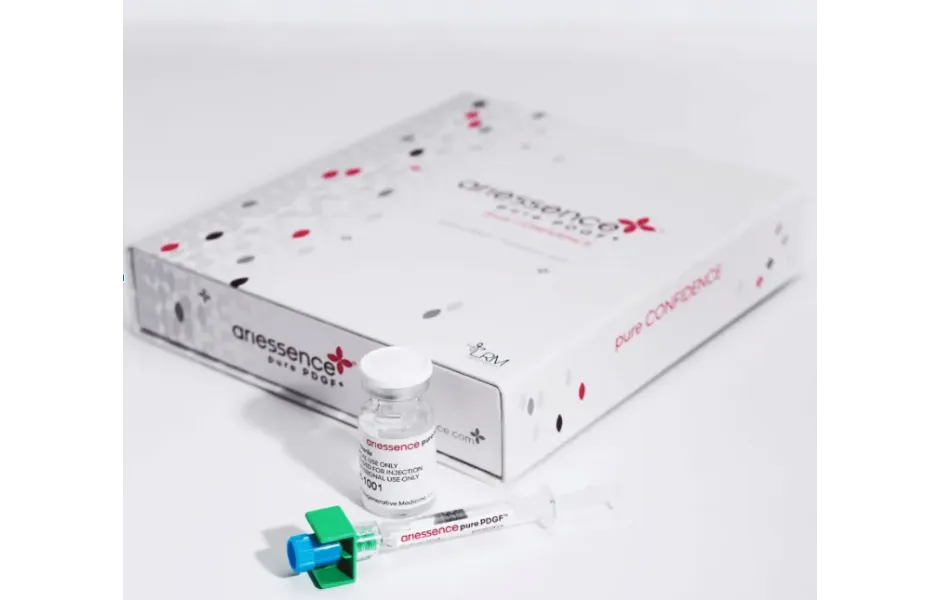
What Ariessence Pure PDGF+ Actually Is
Ariessence skips the blood draw entirely. Its manufacturer produces PDGF-BB using recombinant technology: yeast cells are modified to produce the protein, which then gets purified in a sterile bioreactor down to what the company describes as a four-ingredient formula. No centrifuge, no variability tied to how your blood happens to look that day.
The tradeoff for that convenience is scope. PRP delivers a broad mix of whatever growth factors your platelets are carrying. Ariessence delivers exactly one, PDGF-BB, at what its manufacturer states is a far higher concentration per application than PRP typically provides. That's a company claim, not something independent research has verified yet.
One Ingredient vs a Mixed Bag
Whether narrow-and-concentrated beats broad-and-variable is really the whole PDGF vs PRP question, and it isn't settled by the research yet. PRP's mixed composition means it's also carrying other documented wound-healing factors alongside PDGF, VEGF and TGF-beta among them, which some providers see as an advantage since skin repair genuinely involves more than one signaling pathway. A single, standardized growth factor is easier to dose predictably, but it's also, by definition, doing less at once than a product carrying several factors together.
There's a volume tradeoff too. PRP's growth factor content depends on how many platelets a given patient's blood happens to produce, which varies by age, health, and even time of day. Ariessence sidesteps that variability entirely by manufacturing to a fixed specification, though a fixed specification for one factor isn't automatically the same thing as more total repair signaling than PRP's broader, if less consistent, mix.
Clinical evidence for both approaches is still thin. The Medicina review noted "small sample sizes" and a "lack of standardization in PRP preparation and application" across the 13 studies it examined, a limitation that applies to platelet-based treatments broadly, PDGF-specific products included.
Can You Combine Them?
Not typically as a pair with each other, since both are being asked to do a similar job. Where they do overlap is in pairing with a third procedure. Be Beautiful's PRP page notes it can be combined with microneedling, laser, or injectables, and Ariessence is most often applied immediately after microneedling, a fractional laser, or RF microneedling for the same reason: those procedures create the kind of controlled injury that growth factors, whichever source they come from, are built to respond to.
Practically speaking, that means the decision usually isn't PRP-and-PDGF-together so much as PRP-or-PDGF alongside whatever resurfacing procedure you're already getting. A provider mapping out a treatment plan will typically pick one growth-factor source to pair with microneedling or laser rather than stacking both in the same visit, partly to keep recovery predictable and partly because there's no research yet showing combining them adds a meaningful benefit over using either alone.
Which One Fits You
If avoiding anything derived from your own blood matters to you, or you want a dose that's identical every single time, Ariessence is the more predictable choice. If you'd rather work with a treatment that's been used in aesthetics longer and delivers a broader mix of your own body's healing signals, PRP is the more established option, with Be Beautiful's own data putting results at six to twelve months before a maintenance round. Squeamishness about a blood draw is a real, if less clinical, factor too, and it's a perfectly fair thing to raise at a consultation alongside the clinical questions.
Be Beautiful hasn't published a comparable results-duration figure for Ariessence specifically. That's a fair question to bring straight to a consultation; this post can't answer it for you.
What About Cost?
Pricing isn't posted for either treatment, since both depend on how many sessions your plan calls for and whether PDGF is standalone or paired with something like microneedling. Insurance doesn't cover either one; they're both elective cosmetic treatments. A consultation is the only reliable way to get an actual number for the PDGF vs PRP comparison as it applies to your specific goals.
A Few Terms Worth Knowing
Autologous describes anything made from your own body, which is what makes PRP autologous and Ariessence not. Recombinant means a protein is manufactured using modified cells, not extracted directly from a person, the method behind Ariessence's PDGF-BB. And PDGF-BB itself is just one specific form of platelet-derived growth factor; PRP contains it too, mixed in with several others your platelets naturally carry.
Frequently Asked Questions
Is PDGF the same thing as PRP?
No. PDGF is one growth factor among several that PRP naturally contains. Ariessence Pure PDGF+ isolates just that one factor and delivers it in a standardized, manufactured dose, no blood draw involved.
Which one works better?
Independent research on either one isn't strong enough yet to call a clear winner. It depends more on what you're prioritizing, a broader mix of your own healing factors versus a single, predictable dose.
Is Ariessence safer than PRP since it's not made from blood?
Both are considered low-risk. PRP avoids disease transmission risk because it's your own blood, while Ariessence is a sterile, manufactured product without that concern in the first place. Both carry about the same low risk in Be Beautiful's experience.
Can I try both and see which I prefer?
Some clients do use both, usually at different times, not the same appointment. A provider can help sequence that based on what you're treating.
Does insurance cover either one?
No. Both are elective cosmetic treatments at Be Beautiful, and neither is billed through insurance.
PRP hands you back your own body's healing signals, concentrated. Ariessence Pure PDGF+ hands you one of those same signals, built in a lab to a fixed standard instead. The paper comparison only goes so far; a provider looking at your actual skin is what settles it. Our providers can walk through that at a consultation.
This article is for general education and isn't a substitute for personalized medical advice. Talk with a Be Beautiful provider about your skin and health history before starting any treatment.